

Learning and Remembrance: Culture and Food as Medicine
By Desiree A. Rangel, Program Evaluator
You can smell the roasted chiles from the hallway.
A clinic worker passes by and asks me, “¿Qué están cocinando hoy?”
“I’m not too sure,” I tell him. “It’s always a surprise.”
I’m at Centro San Vicente, where La Semilla’s Community Education team facilitates classes for patients referred by the clinic that are managing diabetes. Here, they’ve attended gardening and cooking classes, seemingly returning to being students in a classroom in anticipation.
As I walk in, the promotoras have already set up for the day. At the center of the room sits a table filled with different types of corn and beans. Around it, an assortment of cookware. Electric skillets, a tortilla press, and even a metate waiting to be used. I feel as if I’ve arrived late, but I haven’t. The participants in this program always arrive early, eager to see what they will learn this time.
Margarita, Cecilia, and Isela have already taken their seats. Margarita makes her usual rounds around the room, greeting everyone with a warmth that fills the space. She’s not the only one that does this, everyone greets each other as if they were old friends, their conversations flow easily and are full of laughter and familiarity.

For many older adults, taking control of their nutritional health can be challenging, especially for those living with diabetes. But at Centro San Vicente, that challenge feels different. It feels shared since they always check each other for any health updates since the last time they saw each other.
Since March, I’ve been observing these classes facilitated by La Semilla’s Community Education staff: Program Coordinator Anahí, and promotoras Analu, Areli, and Lupe. Over time, they’ve built deep relationships with the patients who attend. Trust has grown here along with their knowledge that they all share with each other.
It’s strange being in this space, not because I’m an outsider, but because it feels like stepping back in time. I’m reminded of my grandmother, who always greeted me with food, insisting that I eat no matter what. Her kitchen offered different food, depending on the day. Sometimes it was frijoles con espinacas, sometimes tacos de lengua and even “locas” if my grandpa requested it. I can still see her hands flipping tortillas, her fingertips never feeling the heat coming from the comal.
Being here, surrounded by these elders, feels like being in her kitchen again. This space is full of care, traditions, and nourishment.
The impact of this space is felt. The classes are not just for learning, but for remembering. Stories shared like the recipes: memories of childhoods spent watching tíos tend alfalfa fields while mothers prepared food for the workers; being sent with a sack of tortillas into the fields and hiding between corn stalks after the day’s work was done.
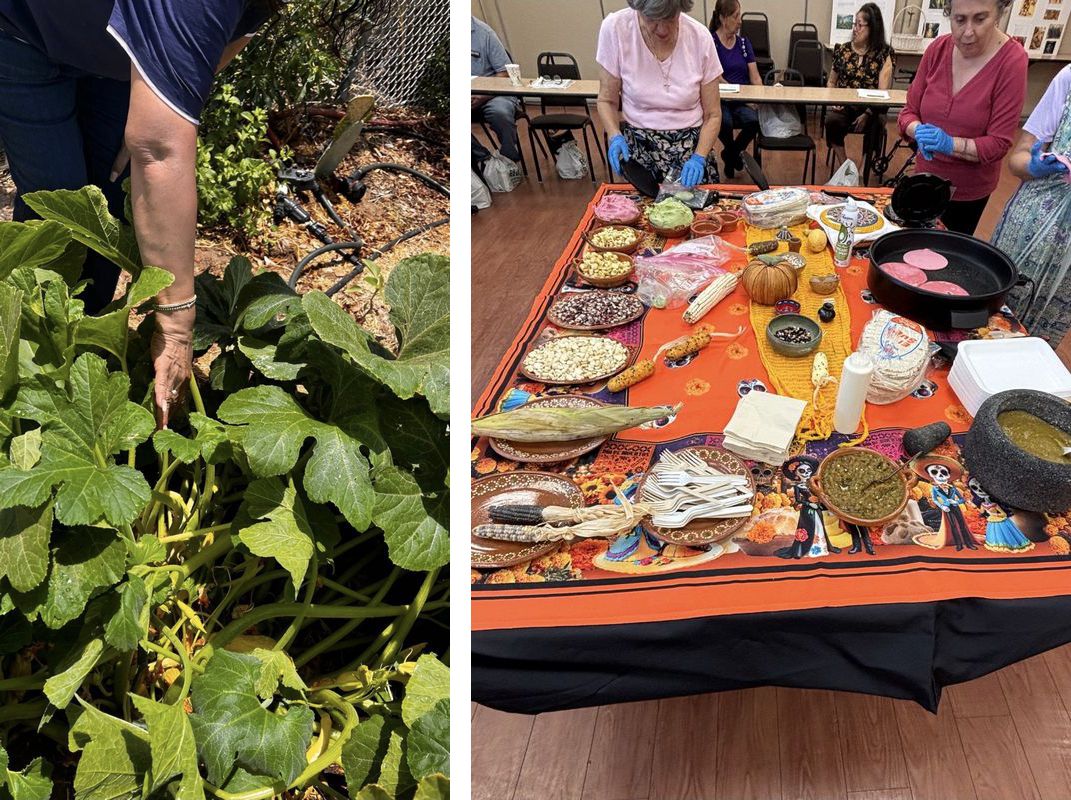
Cecilia recalls her grandmother preparing herbal teas when she was sick with tonsillitis. Others speak of matriarchs who woke before dawn to make and sell tortillas, their hands working fast. Maiz was not just food; it was ritual and connection itself.
When Analu led the maíz class, you could feel a certain weight in the air. It wasn’t just a lesson about mazorcas, it was an act of remembrance. As one participant teared up, she said that she felt a connection to the temples, and understood the systemic effort of stripping indigenous knowledge due to colonization.
The reclamation of cultural traditions has been a constant theme throughout my observation. The patients absorb the ancestral significance of corn, remembering how their elders used to prepare it while incorporating new learned practices into their daily cooking. There is an unspoken understanding of the responsibility of passing down skills and knowledge to younger generations, and I can’t help but feel the need to also be a responsible descendent.
The Food is medicine (FIM) movement recognizes food as a tool to prevent and manage chronic diseases and has gained momentum due to strong bipartisan support. La Semilla has consistently received funding from Gus Schumacher Nutrition Incentive Program (GusNIP) and has supported the Community Education program, in partnership with Centro San Vicente, to continue a Produce Prescription Program for referred patients. Centro San Vicente is located in the Lower Valley which is an older, well established community, rich in culture and history. Beyond conventional measurements such as blood pressure, healthcare costs and vegetable and fruit consumption, La Semilla has taken the opportunity to document ecological and social principles inspired by the agroecology movement. This holistic approach centers around understanding impacts on food practices, cultural belonging, knowledge exchange, local, circular economies and care. For example, La Semilla’s program provides a model that not only supports patients but local farmers that provide produce in these produce boxes. The impact on the Centro San Vicente community is profound. Beyond blood pressure and A1C measurements, it’s the smell of fresh tortillas down the hall to the elevator, stories of grandparents selling tortillas in Juarez, the jackfruit carefully prepared and shared in class, the tight hugs as they say goodbye, and the warmth of knowing that humanity goes beyond what dictates health, but how we show up for each other.