
Food, Land, and Memory: The Development of the Paso del Norte Food System Timeline
By Ser Godoy

As I walk to meet Haylee for the first time, I see her in the field at La Semilla Community Farm, hanging pieces of paper from two clotheslines along with other staff members. I know she’s preparing an activity for the staff meeting, and I can’t wait to see it. I say hi from a far and I can sense in her gleeful response the kindness that I’ve now come to cherish whenever we see each other. As I come close, I finally make them out: two timelines showing the history of food systems, one for the United States, and another one for the El Paso del Norte Region.

It’s a sunny day at the farm, and the wind is starting to pick up, but Haylee looks happy to see her work laid out across the field. As I walk across the timelines, one laid out above the other, I feel the enormity of the task. The story assembled on these pieces of paper goes back thousands of years, and is directly related to the land I’m standing on. There’s a depth to the way humans have inhabited and related to the Americas that has been kept out of our education, a history of reciprocity, challenge and resistance that goes back at least 10,000 years, when Indigenous communities “sustainably use(d) fire, prayer, and natural fertility to clear grazing lands for buffalo and wild game, manage edges for fruiting brambles, and maintain intercrops of sacred maize, beans, squash and other crops.”* We are inheritors of that story, and seeing it laid out makes the stakes of the present feel tangible. It dawns on me that this point in history will be part of a future timeline assembled by a future Haylee studying what challenges we faced and what decisions we made to continue the legacy of agroecology and food equity in the region.
When I ask Haylee why it is important to have a timeline for the region, she tells me it is “because it highlights the events that have molded our home and community and not only brings voices forward that could easily be silenced and forgotten, but also brings voices forward from so many areas like Las Cruces, Juarez, El Paso, Anthony, etc. This history bridges stories across borders and shows our people where we came from and the roots and resistance/perseverance that our ancestors and others had.” As migration becomes ever more policed, and state borders more violent, highlighting the roots, resistance, and perseverance that supported our communities in the region feels like an important reminder that we’ve been together longer than we’ve been apart.
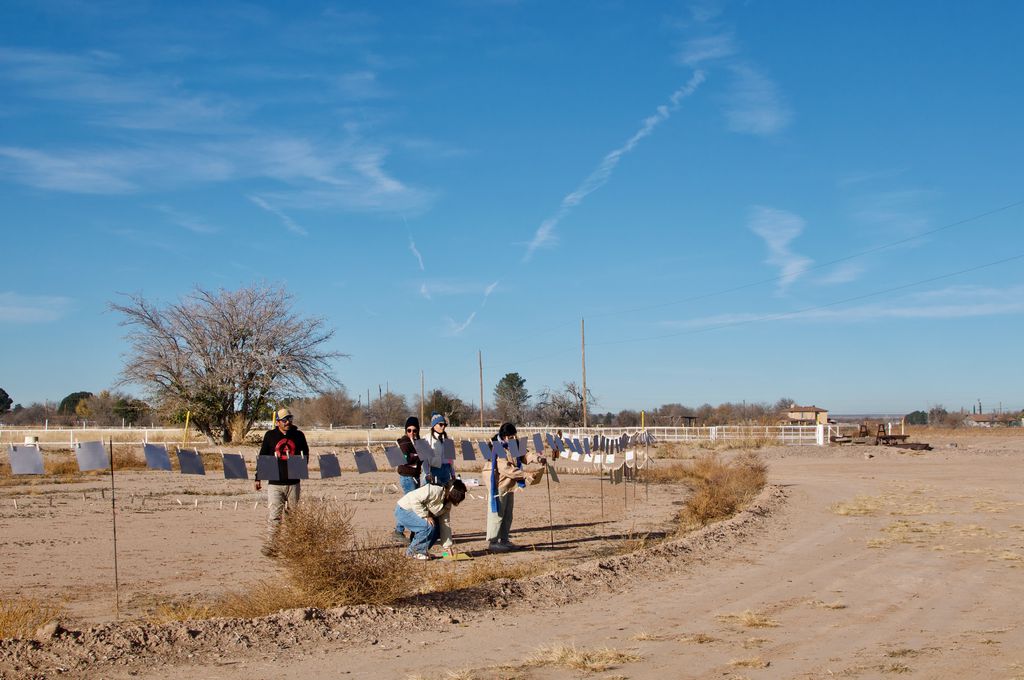
As the staff meeting starts, the strong winds start ripping the pieces of paper from the clotheslines, and Haylee and other staff members have to run out into the field to get them, while others park their cars behind the timelines to make a barrier from the wind. Days later Haylee would tell me how when she first encountered the National Timeline, developed by Soul Fire Farm, she felt it was hard to go through, as so much of the history of food systems and land has been tied to white supremacist systems of oppression. It’s never been an easy job to assemble the history of oppressed people, and as I remember La Semilla staff gathering the timelines to keep them safe from the wind, I can’t help but feel an echo of history, of all the people that went out into the fields to record their history before it was erased or forgotten.
This resonates with something Alina Rayas, an Arts Educator and one of the facilitators who first introduced Haylee to the National Timeline at La Semilla as part of their youth program “Joy and Justice,” told me when I reached out to her to find out more about that experience; she told me that in that first exercise, one of the main questions they had for the participants was “what does it mean to be a good ancestor?” and that to her, “to be a good ancestor has many meanings, one of them is to heal one’s relationship to time to its expansive, nonlinear, circular nature. Timelines can be vital for folks who have been robbed of our histories. Timelines can be starting places to begin our way back to relationships with ancestral time/land.” Taking part in the creation of a timeline, doing the work of going back and looking at the archive and assembling all the pieces together to tell the story of her community is the task of an ancestor, and Haylee’s up to the task.

La Semilla had been working with Soul Fire Farm’s national timeline for several years in youth and policy programs, and Soul Fire Farm’s research had been critical in development of La Semilla’s publication Food, Land, and Us: A Look at the Farm Bill from the Paso del Norte Region in 2021. Since then, additional Storytelling Program efforts had included the ClimateLore oral history project in 2024 and was gearing up to pilot a Food Stories Institute in early 2025. As part of these efforts, Rubí Orozco Santos, the head of the Storytelling Program, identified the need to know more about what the history of the food system and food justice could look like locally. Inspired by Soul Fire Farm’s model, in December of 2024 she asked Haylee to assemble a regional timeline.
Haylee started assembling the timeline using written sources recommended to her by Rubí and Michelle Carreon from the Storytelling program, and Julieta Saucedo from the Farm team. She also interviewed people who have been involved in local food and farming organizing in the last 15 years, including La Semilla’s Executive Director Cristina Dominguez, and eventually went to the Border Heritage Center at the Main Library in Downtown El Paso. There, she was shown an extensive archive with the history of the region. The archive is held in filing cabinets, which Haylee navigated through key words given to her by one of the librarians, she read through “newspapers, newsletters, pictures, magazines, other forms of writing. It honestly was life changing, just because I was like wow, there’s so much material out there (…) I felt like time was going by and I didn’t even notice.”
Something that happens when you dive into a local archive as deep as the Border Heritage Center is that you realize how much you don’t know about where you live, something that Haylee discovered as she read about Francis Boyer and Carmelita Torres, “After learning about Francis Boyer and his relocating to Vado, NM where he introduced dry farming techniques and about Carmelita Torres who was so young yet so full of life and fierceness when leading a protest against the use of Zyklon B, I found myself always coming back to their stories and events in my research. These specific moments in history showed me that there is always a light in the dark and that despite troubling times, like seeds in the ground, we sprout and prosper.”
Looking through the materials took several weeks and more than a couple of eyes, as Haylee enlisted her sister for help, asking her to read through articles and give her summaries about what she’d read. She finally started assembling the timeline once they had combed through the archive, and described the experience as “piecing together a puzzle to get a view of a larger-scaled image. I began by asking myself what was the story I wanted the timeline to tell, a historical approach and reflective approach or more of a logistical and direct approach? “What seems more important? What would readers like to know?” and once I focused on the different resources I had gathered, I sorted through them in terms of what I really wanted to include, what was more of a maybe, and what we could exclude, and got input from others who revised it for me and let me know what they thought was more relevant.” Part of her process also included checking Soul Fire Farm’s National Timeline to keep the chronology straight, and seeing what information could become repetitive, as the plan was for the two timelines to be shown together.
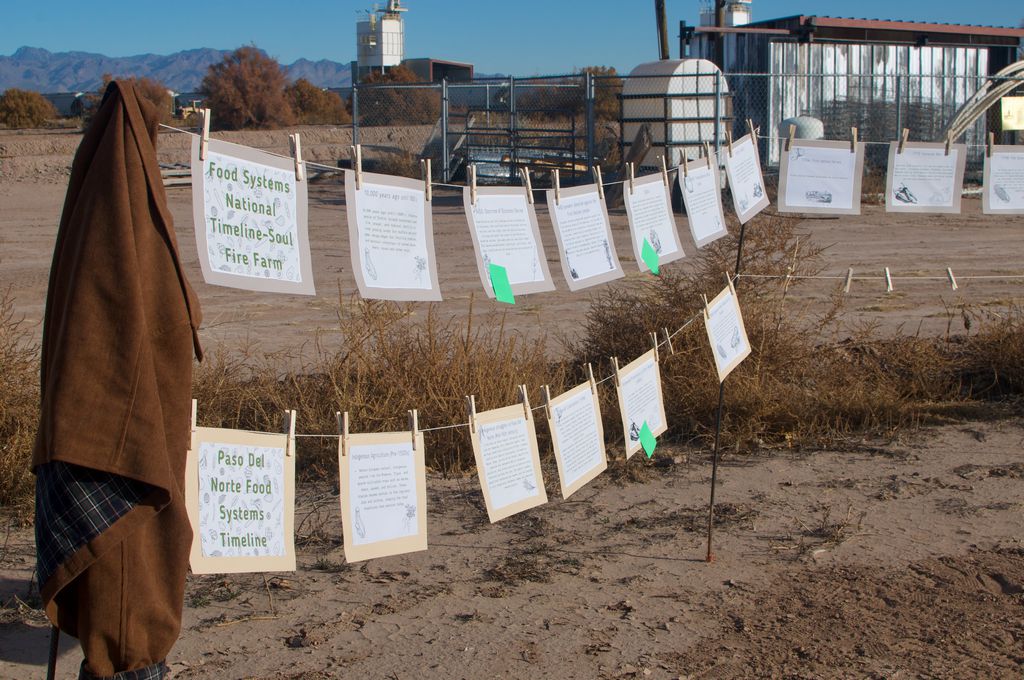
After a quick pivot to escape the unforgiving wings, we finally reconvene inside the La Semilla main office to look at the timelines, which are now pasted on the walls. For the exercise, Haylee asks us to leave post-its on events that catch our eye, or write down questions that come up as we go through the events. She also asks that we add events we know about if we think they are missing from the timeline. People go up to the timelines and start walking slowly, reading each entry carefully. It’s sometimes jarring to keep comparing the National Timeline with the Regional one, as we can see the larger context and zoom in to see our part in the larger story, like in the 1600’s, when there was upheaval in the 13 Colonies through the resistance of indigenous people to their colonization, while at the same time, Chili Peppers were introduced to Spanish cooking in the border region, starting what would eventually become a staple of southwestern cuisine.
Other times, it’s hard not to notice the gaps, like the lack of Mexican sources on the regional archive. When I asked Haylee about this, she said she’d included as much as she found, but it seems like the archives themselves are created by the borders that divide the land. She said the knowledge she’s gathered from Mexico has come from people who she interviewed, which is a powerful reminder of how important oral histories still are.

By the end of the exercise, there’s a deep sense of how big the history is, the legacy that we carry as we try to build new relationships to land and food. There’s also a sense that we all can contribute to the telling of the story, to the spots we are on the timeline that envelops us.
I appreciate the way Haylee facilitates the exercise, because it lets me see one of the values I see in La Semilla, which is knowing the process can be as important as the result. A timeline is a story, assembled in one way, with a point of view, and when you accept that, like Haylee does, you can open the story to the voices around you, and together create a richer and more complex story, which can hold all of us.
When I ask her how she sees her timeline being used in the future, she tells me that “this timeline carries the ‘memory’ of the Paso Del Norte food system, tracing injustice, resilience, and the hands that shaped the land. It honors those who came before us, revealing how past choices still shape access, labor, and nourishment today. In the future, it becomes both mirror and map; teaching, grounding and guiding the region toward food sovereignty rooted in history, justice, and community strength.” Spoken like a good ancestor.
—————–
To access the Paso del Norte Food System Timeline, please contact La Semilla’s Community Farm Team at farm@lasemillafoodcenter.org